
The BC Building Code defines the energy performance targets of the Step Code based on the building’s climate zone (CZ). The BC climate zones are defined by the average heating degree-days below 18° C (HDD). The BC Building Code states that the authority having jurisdiction (AHJ) can establish climatic values to define climate zones, typically based on information from Environment Canada, and building designers must consult the AHJ before making any assumptions about a building’s climate zone. Note that in some locations, there may be several climate zones due to variations in elevation.
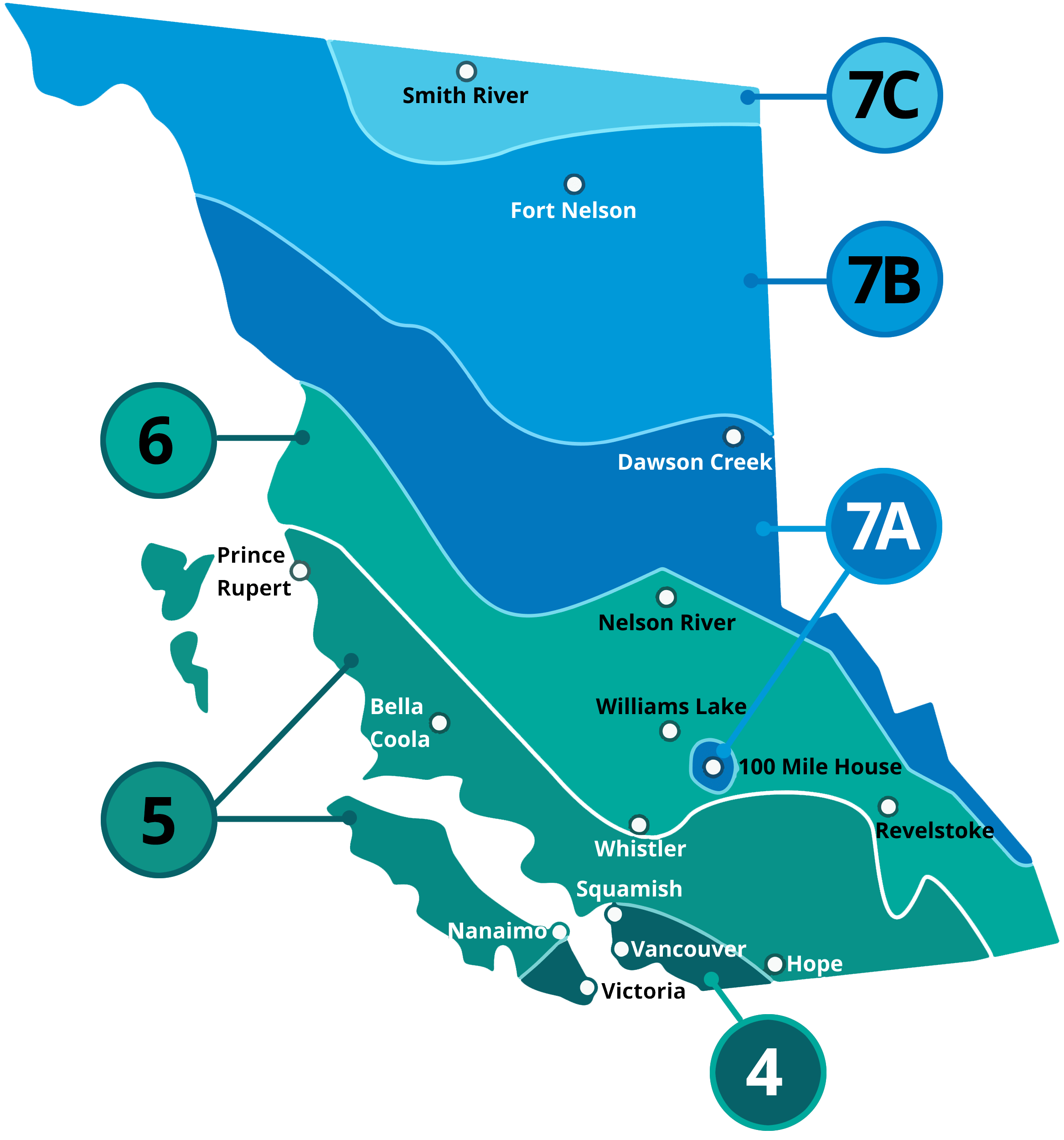
Climate Zone 4 | < 3,000 HDD
Abbotsford
Agassiz
Burnaby*
Chilliwack
Crofton
Duncan
Delta
Maple Ridge
Jordan River
Langford
Langley
Mission
New Westminster
North Vancouver*
Port Renfrew
Richmond
Sechelt
Sidney
Sooke
Squamish
Surrey
Vancouver
Victoria
West Vancouver
White Rock
Climate Zone 5 | 3,000 to 3,999 HDD
Albernl
Ashcroft
Bamfield
Bella Bella
Bella Coola
Burnaby (SFU)
Cache Creek
Campbell River
Castlegar
Comox
Courtenay
Crescent Valley
Gold River
Grand Forks
Hope
Kamloops
Kaslo
Kelowna
Kitimat Plant
Kitimat Townsite
Ladysmith
Lillooet
Lytton
Masset
Merritt
Montrose
Nakusp
Nanaimo
Nelson
Ocean Falls
Osoyoos
Parksville
Penticton
Port Alberni
Port Alice
Port Hardy
Port McNeill
Powell River
Prince Rupert
Qualicum Beach
Queen Charlotte City
Salmon Arm
Sandspit
Tahsis
Tofino
Trail
Ucluelet
Vernon
Youbou
Climate Zone 6 | 4,000 to 4,999 HDD
Carmi
Cranbrook
Dog Creek
Elko
Fernie
Golden
Greenwood
Kimberley
McBride
Prince George
Princeton
Quesnel
Revelstoke
Stewart
Terrace
Whistler
Williams Lake
Climate Zone 7A | 5,000 to 5,999 HDD
100 Mile House
Glacier
Burns Lake
Mackenzie
Chetwynd
McLeod Lake
Dawson Creek
Smithers
Fort St. John
Taylor
Climate Zone 7B
6,000 to 6,999 HDD
Beatton River
Dease Lake
Fort Nelson
Climate Zone 7C
> 7,000
Smith River
* denotes locations with multiple climate zones